Chances of Having a Baby at 37 Weeks
In her living room, Caroline Nagy introduces the newest fellow member of her family unit — the half-dozen-week-old infant in a striped onesie cradled in her artillery. "This is Alex Joseph. He was built-in May 24th — my birthday," she says.
Their shared birthday wasn't entirely a coincidence. Ii weeks before her due engagement, Nagy was swollen, and uncomfortable. So she asked her doctor for relief.
"I was just miserable. It was similar uncomfortable to walk; I couldn't sit on the floor and play; I felt like I was neglecting my first kid because I just couldn't motility and I couldn't exercise annihilation," says Nagy. "And then I asked, 'Is in that location any style I tin can speed this up and have a baby earlier?' "
For Jackie McGinty, it wasn't discomfort but timing that caused her to schedule her daughter'south nativity by C-section eight years ago. McGinty'south first kid was delivered by C-section for medical reasons, and although this time around she had hoped to deliver naturally, she had but moved out of country and wanted her family nearby to help with the baby.
"My mom was coming out and she was only going to come out for a few weeks. I needed her to exist there later on the birth. ... Then having the option to schedule information technology was skilful for us," says McGinty.
Harm In Planning Besides Far Alee?
Stories like these are common. Statistics show that from 1990 to 2006 the per centum of women who induced labor more than doubled, and almost a third of women were having cesareans.

Caroline Nagy and her now 8-week-old baby in Youngstown, Ohio. Nagy says she had labor induced early at 39 weeks because she was uncomfortable and felt every bit though she was neglecting her other child. Gretchen Cuda Kroen for NPR hibernate caption
toggle caption
Gretchen Cuda Kroen for NPR
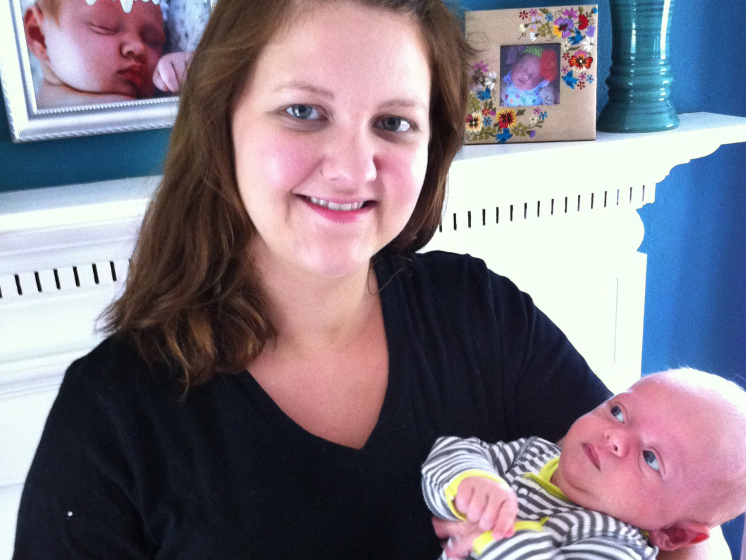
Caroline Nagy and her at present 8-calendar week-old infant in Youngstown, Ohio. Nagy says she had labor induced early at 39 weeks because she was uncomfortable and felt every bit though she was neglecting her other child.
Gretchen Cuda Kroen for NPR
The increase wasn't because of emergencies, says Jay Iams, a specialist in maternal fetal medicine at Ohio Country Academy, just rather because women and doctors began scheduling deliveries for convenience — "convenience for the female parent, for the family unit, for the doc," says Iams. Sometimes, Iams says, it'due south because patients say to themselves, " 'I want just my doctor to exist there. I don't want the person who's on telephone call.' "
Having a infant naturally requires lots of planning. But when it comes to the arrival date of your bundle of joy, experts now say that planning too far ahead can practice more harm than good.
A full-term pregnancy lasts twoscore weeks, merely elective deliveries are often planned for two or three weeks earlier. And even though 37 weeks is also nevertheless considered total term, studies show that babies born even a few weeks too early on are at greater take a chance for health problems than those who are born later. That has some doctors campaigning to curb the trend of scheduled labor and delivery.
Pediatrician Ed Donovan of Cincinnati Children's Infirmary says data collected over the by several decades prove those babies have an increased risk of complications compared with waiting until the mother goes into labor spontaneously.
"It'southward now actually well-documented in national studies that the risk of the baby having to require intensive intendance in a neonatal intensive intendance unit — even the risk of babe death — is increased when the babe is born every bit little as two weeks before the due engagement," says Donovan.
Organ Systems Maturing At Different Rates
The reasons for this are two-fold. Commencement, without an ultrasound measurement in the first trimester, a woman's due date could exist equally much equally 2 weeks off, making the fetus 35 weeks instead of 37. And 2d, Donovan says the brain, heart, lungs, and allowed arrangement all mature at different rates — and some may need a little more fourth dimension than others.
"Just because the lungs are mature doesn't mean that the other organ systems are mature," says Donovan. "A infant born iii weeks early with mature lungs may not be ready to eat considering the brain'southward not fully developed."
According to Donovan, doctors realized they simply weren't very good at determining which babies were ready and which weren't. And Iams says the large numbers of ill babies made many doctors begin to think differently about early on deliveries.

"30-7 weeks is term, but they became the near common occupants of neonatal intensive care nurseries," says Iams. "And the pediatricians naturally said, 'They could have waited.' "
Yet, many women and fifty-fifty many obstetricians remained unaware of the risks considering it didn't fit with their experience.
"People see their friends having babies early, and sometimes women become into labor on their own at 37, 38 weeks — and that's not unusual and those babies are fine," says Jennifer Bailit, an obstetrician at Metro Health Medical Eye in Cleveland. "But those are babies that have told us that they're coming and that they're ready."
Disarming Mothers Information technology's Worth The Wait
Bailit is part of an endeavor led by Iams and Donovan to reduce the number of scheduled deliveries before 39 weeks beyond the state of Ohio. Bailit says that she often has to explain to women the importance of those last few weeks — and that the discomfort is normal only something that needs to exist endured for the sake of the babe.
"Information technology's tough to be pregnant, and sometimes when you're in the moment information technology'south hard to keep the large picture in listen," Bailit says. "When nosotros guide people toward that kind of thinking it really helps them say, 'I'm doing this for my baby; information technology's worth it.' "
In addition to helping doctors like Bailit educate pregnant women, Iams and Donavan asked doctors at the twenty largest hospitals in the country to certificate a medical reason every time a woman was scheduled to deliver before 39 weeks. And much to their surprise, Iams says in under 15 months the rates of those deliveries dropped from 15 percent to under 5 percent. And more important, the number of babies admitted to neonatal intensive intendance also decreased.
And the thought is catching on beyond the country. The March of Dimes has taken what began in Ohio and a few other select states and extended it nationwide in a campaign it'south calling "Salubrious Babies are Worth the Wait." Alan Fleischman of the March of Dimes says the rate of elective births in the hospitals the organization has surveyed is about 30 per centum.
"Almost infirmary leaders don't believe they accept this trouble until they actually measure it," says Fleischman. "And when they do, they're surprised."
Equally in Ohio, their preliminary data testify that in only a short flow of time, even hospitals with very loftier rates of scheduled deliveries are able to reduce them to about 5 per centum or less past making a few simple changes — and in plough, increase the likelihood of a healthy baby.
Although inductions at 39 weeks and beyond are considered safe, some doctors experience that unless at that place is a medical reason to deliver early, the best labor plan for women is an old-fashioned i: Hang in there and look until labor starts on its own.
Chances of Having a Baby at 37 Weeks
Source: https://www.npr.org/2011/07/18/138473097/doctors-to-pregnant-women-wait-at-least-39-weeks
0 Response to "Chances of Having a Baby at 37 Weeks"
Post a Comment