If You Have a Baby and Then Get Married Are They Still a Bastard
Legitimacy, in traditional Western common constabulary, is the status of a kid born to parents who are legally married to each other, and of a kid conceived before the parents obtain a legal divorce. Conversely, illegitimacy (or bastardy) has been the condition of a child born outside marriage, such a child being known as a bastard, a love kid, a natural child, or illegitimate.
In Scots police, the terms natural son and natural girl bear the same implications.
The importance of legitimacy has decreased considerably in Western countries since the sexual revolution of the 1960s and 1970s and the declining influence of Christian churches on family life. Births outside marriage at present represent the majority in many countries of Western Europe and in many former European colonies. In many Western-derived cultures, stigma based on parents' marital condition, and utilize of the word "bastard", are now considered offensive.
Constabulary [edit]
England'southward Statute of Merton (1235) stated, regarding illegitimacy: "He is a bastard that is born earlier the marriage of his parents."[ane] This definition as well applied to situations when a child's parents could not marry, as when one or both were already married or when the relationship was incestuous.
The Poor Constabulary of 1576 formed the basis of English bastardy law. Its purpose was to punish a bastard child'southward mother and putative father, and to relieve the parish from the cost of supporting mother and kid. "Past an human action of 1576 (18 Elizabeth C. 3), information technology was ordered that bastards should be supported by their putative fathers, though bastardy orders in the quarter sessions engagement from earlier this date. If the genitor could exist establish, then he was put under very slap-up pressure level to take responsibility and to maintain the child."[2]
Under English law, a bastard could not inherit real property and could not be legitimized by the subsequent marriage of father to female parent. There was ane exception: when his begetter subsequently married his mother, and an older illegitimate son (a "bastard eignè") took possession of his father'south lands after his decease, he would laissez passer the state on to his ain heirs on his death, as if his possession of the land had been retroactively converted into truthful buying. A younger non-bounder brother (a "mulier puisnè") would have no merits to the country.[3]
In that location were many "natural children" of Scotland'south monarchy granted positions which founded prominent families. In the 14th century, Robert 2 of Scotland gifted 1 of his illegitimate sons estates in Bute, founding the Stewarts of Bute, and similarly a natural son of Robert III of Scotland was ancestral to the Shaw Stewarts of Greenock.[4]
In Scots law an illegitimate child, a "natural son" or "natural daughter", would be legitimated past the subsequent matrimony of his parents, provided they were free to marry at the engagement of the conception.[v] [6] The Legitimation (Scotland) Act 1968 extended legitimation past the subsequent union of the parents to children conceived when their parents were not free to marry, but this was repealed in 2006 by the amendment of department ane of the Law Reform (Parent and Child) (Scotland) Act 1986 (equally amended in 2006) which abolished the status of illegitimacy stating that "(1) No person whose status is governed by Scots law shall exist illegitimate ...".
The Legitimacy Act 1926 [7] of England and Wales legitimized the birth of a child if the parents subsequently married each other, provided that they had not been married to someone else in the meantime. The Legitimacy Act 1959 extended the legitimization even if the parents had married others in the meantime and applied it to putative marriages which the parents incorrectly believed were valid. Neither the 1926 nor 1959 Acts changed the laws of succession to the British throne and succession to peerage and baronetcy titles. In Scotland children legitimated by the subsequent matrimony of their parents accept ever been entitled to succeed to peerages and baronetcies and The Legitimation (Scotland) Human activity 1968 extended this right to children conceived when their parents were not complimentary to marry.[8] The Family Law Reform Act 1969 (c. 46) allowed a bastard to inherit on the intestacy of his parents. In canon and in civil law, the offspring of putative marriages have also been considered legitimate.[9]
Since December 2003 in England and Wales, April 2002 in Northern Republic of ireland and May 2006 in Scotland, an unmarried father has parental responsibleness if he is listed on the birth certificate.[10]
In the The states, in the early on 1970s a series of Supreme Court decisions held that most common-law disabilities imposed upon illegitimacy were invalid every bit violations of the Equal Protection Clause of the Fourteenth Amendment to the United States Constitution.[11] Still, children born out of union may not be eligible for certain federal benefits (e.one thousand., automatic naturalization when the male parent becomes a United states of america citizen) unless the child has been legitimized in the appropriate jurisdiction.[12] [xiii]
Many other countries take legislatively abolished any legal disabilities of a child born out of marriage.[fourteen] [ citation needed ]
In France, legal reforms regarding illegitimacy began in the 1970s, just information technology was only in the 21st century that the principle of equality was fully upheld (through Act no. 2002-305 of 4 March 2002, removing mention of "illegitimacy" — filiation légitime and filiation naturelle; and through law no. 2009-61 of 16 January 2009).[15] [sixteen] [17] In 2001, France was forced past the European Court of Homo Rights to change several laws that were deemed discriminatory, and in 2013 the Court ruled that these changes must likewise be applied to children built-in earlier 2001.[18]
In some countries, the family unit police force itself explicitly states that there must be equality betwixt the children built-in exterior and within marriage: in Bulgaria, for example, the new 2009 Family Lawmaking lists "equality of the built-in during the matrimony, out of union and of the adopted children" as one of the principles of family law.[19]
The European Convention on the Legal Status of Children Born out of Union [20] came into forcefulness in 1978. Countries which ratify information technology must ensure that children born outside matrimony are provided with legal rights as stipulated in the text of this convention. The convention was ratified past the Uk in 1981 and past Ireland in 1988.[21]
In later years, the inheritance rights of many illegitimate children have improved, and changes of laws have allowed them to inherit properties. More recently, the laws of England take been changed to allow illegitimate children to inherit entailed holding, over their legitimate brothers and sisters.[ citation needed ]
Contemporary state of affairs [edit]
Despite the decreasing legal relevance of illegitimacy, an important exception may be found in the nationality laws of many countries, which do not apply jus sanguinis (nationality by citizenship of a parent) to children built-in out of spousal relationship, particularly in cases where the child's connection to the state lies only through the father. This is true, for instance, of the The states,[22] and its constitutionality was upheld in 2001 by the Supreme Court in Nguyen five. INS.[23] In the UK, the policy was changed then that children born after 1 July 2006 could receive British citizenship from their father if their parents were unmarried at the time of the child's birth; illegitimate children built-in before this date cannot receive British citizenship through their begetter.[24]

Legitimacy besides continues to be relevant to hereditary titles, with only legitimate children beingness admitted to the line of succession. Some monarchs, however, have succeeded to the throne despite the controversial status of their legitimacy. For example, Elizabeth I succeeded to the throne though she was legally held illegitimate as a result of her parents' marriage having been annulled afterwards her birth.[25] Her older half-sister Mary I had acceded to the throne before her in a similar circumstance: her parents' union had been annulled in order to let her father to ally Elizabeth's mother.
Annulment of wedlock does non currently modify the status of legitimacy of children born to the couple during their putative marriage, i.e., between their marriage ceremony and the legal annulment of their spousal relationship. For example, canon 1137 of the Roman Cosmic Church's Code of Canon Police specifically affirms the legitimacy of a child born to a union that is alleged null following the child's birth.[26]
The Catholic Church building is also irresolute its attitude toward unwed mothers and baptism of the children. In criticizing the priests who refused to baptize out-of-union children, Pope Francis argued that the mothers had washed the right matter by giving life to the kid and should not exist shunned past the church:[27] [28] [29]
In our ecclesiastical region there are priests who don't baptise the children of unmarried mothers because they weren't conceived in the sanctity of marriage. These are today's hypocrites. Those who clericalise the church. Those who separate the people of God from salvation. And this poor girl who, rather than returning the kid to sender, had the courage to carry it into the world, must wander from parish to parish so that it's baptised!
Nonmarital births [edit]
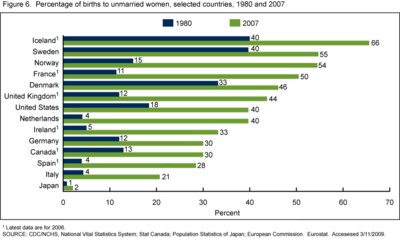
Percent of births to unmarried women, selected countries, 1980 and 2007.[30]

The proportion of children born exterior marriage is ascension in all EU countries,[48] Due north America, and Commonwealth of australia.[49] In Europe, besides the low levels of fertility rates and the delay of motherhood, some other cistron that at present characterizes fertility is the growing per centum of births outside marriage. In the Eu, this miracle has been on the rise in recent years in almost every land; and in seven countries, generally in northern Europe, it already accounts for the majority of births.[50]
In 2009, 41% of children built-in in the Usa were born to unmarried mothers, a significant increase from the 5% of half a century earlier. That includes 73% of non-Hispanic blackness children, 53% of Hispanic children (of all races), and 29% of not-Hispanic white children.[51] [52] In April 2009, the National Eye for Health Statistics announced that nearly 40 percent of American infants born in 2007 were born to an unwed female parent; that of 4.3 million children, 1.7 one thousand thousand were born to unmarried parents, a 25 per centum increase from 2002.[53] Most births to teenagers in the U.s. (86% in 2007) are nonmarital; in 2007, 60% of births to women 20–24, and nearly one-third of births to women 25–29, were nonmarital.[30] In 2007, teenagers accounted for just 23% of nonmarital births, downwardly steeply from fifty% in 1970.[30]
In 2014, 42% of all births in the 28 Eu countries were nonmarital.[54] In the following European countries the majority of births occur outside marriage: Iceland (69.9% in 2016[54]), France (59.seven% in 2016[55]), Bulgaria (58.6% in 2016[56]), Slovenia (58.vi% in 2016[57]), Norway (56.2% in 2016[54]), Estonia (56.i% in 2016[56]), Sweden (54.nine% in 2016[54]), Denmark (54% in 2016[54]), Portugal (52.8% in 2016[58]), Belgium (50,half-dozen% in 2015 [59]), and kingdom of the netherlands (50.4% in 2016[56]).
The proportion of nonmarital births is likewise budgeted half in the Czech Republic (49.0% in 2017[lx]), the United Kingdom (48.2% as of 2017[54]), Republic of hungary (46.7% as of 2016[54]), Spain (45.9% as of 2016[56]), Finland (44.9% as of 2016[56]), Austria (42.1% as of 2015[56]). Only six EU countries (Hellenic republic, Croatia, Cyprus, Poland, Republic of lithuania and Italy) have a percent of nonmarital births below 30%.[61] The lowest proportions of births outside marriage, among EU countries in 2017, were found in Greece (x.3%), Croatia (19.9%) and Cyprus (xx.3%).[54]
The prevalence of births to single women varies not only between different countries, merely besides betwixt different geographical areas of the aforementioned country: for example, in Deutschland, there are very strong differences between the regions of former West Germany and Eastward Germany with a non-religious majority. Significantly more children are born out of matrimony in eastern Deutschland than in western Germany. In 2012, in eastern Germany 61.6% of births were to unmarried women, while in western Frg but 28.iv% were.[62] In the U.k., in 2014, 59.4% of births were nonmarital in N Eastward of England, 58.9% in Wales, 54.ii% in North West England, 52.4% in Yorkshire and the Humber, 52% in Due east Midlands, l.8% in Scotland, 50.4% in West Midlands, 48.5% in South West England, 45.v% in East of England, 43.2% in Northern Republic of ireland, 42.9% in South East England, and 35.7% in London.[63] In France, in 2012, 66.9% of births were nonmarital in Poitou-Charentes,[64] while simply 46.half dozen% were in Ile-de-France (which contains Paris).[65] One of the reasons for the lower prevalence of nonmarital births in the city is the high number of immigrants from bourgeois world regions.[66] In Canada, in Quebec, the majority of births since 1995 onwards have been outside wedlock.[67] As of 2015, 63% of births were exterior marriage in Quebec.[68]
In the Eu, the average per centum of nonmarital births has risen steadily in recent years, from 27.4% in 2000 to 40% in 2012.[54]
Traditionally conservative Cosmic countries in the Eu at present as well accept substantial proportions of nonmarital births, as of 2016 (except where otherwise stated):[54] Portugal (52.8% [58]), Spain (45.9%), Republic of austria (41.vii%[69]), Luxembourg (40.7%[54]) Slovakia (40.2%[56]), Ireland (36.five%),[70] Malta (31.8%[56]).
To a sure degree, religion (the religiosity of the population - see Religion in Europe) correlates with the proportion of nonmarital births (e.thousand., Hellenic republic, Cyprus, Croatia take a depression per centum of births outside spousal relationship), but this is not always the case: Portugal (52.viii% in 2016[58]) is among the almost religious countries in Europe.
The percentage of first-born children built-in out of wedlock is considerably higher (past roughly 10%, for the European union), as spousal relationship oft takes place after the first infant has arrived. For example, for the Czech republic, whereas the total nonmarital births are less than half, 47.7%, (third quarter of 2015) the percentage of first-born outside marriage is more than half, 58.2%.[71]
Latin America has the highest rates of non-marital childbearing in the globe (55–74% of all children in this region are born to single parents).[72] In most countries in this traditionally Catholic region, children born outside matrimony are now the norm. Recent figures from Latin America show non-marital births to exist 74% in Republic of colombia, 70% in Paraguay, 69% in Peru, 63% in the Dominican Commonwealth, 58% in Argentina, 55% in Mexico.[73] [74] [75] In Brazil, non-marital births increased to 65.eight% in 2009, upward from 56.ii% in 2000.[76] In Chile, non-marital births increased to 70.7% in 2013, up from 48.3% in 2000.[77]
Even in the early on 1990s, the phenomenon was very common in Latin America. For example, in 1993, out-of-matrimony births in United mexican states were 41.5%, in Chile 43.6%, in Puerto Rico 45.8%, in Costa rica 48.two%, in Argentina 52.7%, in Belize 58.one%, in El Salvador 73%, in Suriname 66% and in Panama 80%.[78]
Out-of-wedlock births are less mutual in Asia: in 1993 the rate in Nippon was 1.iv%; in Israel, three.1%; in China, 5.half-dozen%; in Uzbekistan, half-dozen.four%; in Kazakhstan, 21%; in Kyrgyzstan, 24%.[78] However, in the Philippines, the out-of-marriage birth rate was 37% in 2008–9,[74] which skyrocketed to 52.ane% by 2015.[79]
Covert illegitimacy [edit]
Covert illegitimacy is a situation which arises when someone who is presumed to be a kid's father (or mother) is in fact non the biological father (or mother). Frequencies equally high equally xxx% are sometimes causeless in the media, but research[lxxx] [81] by sociologist Michael Gilding traced these overestimates back to an informal remark at a 1972 conference.[82]
The detection of unsuspected illegitimacy can occur in the context of medical genetic screening,[83] in genetic family name research,[84] [85] and in immigration testing.[86] Such studies bear witness that covert illegitimacy is in fact less than 10% among the sampled African populations, less than 5% among the sampled Native American and Polynesian populations, less than 2% of the sampled Middle Eastern population, and generally 1%-2% among European samples.[83]
Causes for rising in nonmarital births [edit]
The rising in illegitimacy noted in United kingdom of great britain and northern ireland throughout the eighteenth century has been associated with the rising of new employment opportunities for women, making them less dependent upon a husband's earnings.[87] However, the Marriage Act 1753 sought to curb this practice, by combining the spousals and nuptials; and past the start of the 19th century, social convention prescribed that brides be virgins at marriage, and illegitimacy became more socially discouraged, especially during the Victorian era.[88] Later in the 20th century, the social changes of the 1960s and 1970s started to reverse this trend, with an increase in cohabitation and alternative family formation.
Elsewhere in Europe and Latin America, the increase in nonmarital births from the late 20th century on has been linked to secularization, enhanced women'south status, and the fall of authoritarian political regimes.[89] [xc] [91]
Before the fall of communist regimes in Europe, they had encouraged women's participation in the workforce but had discouraged free choice regarding personal life, with the family existence tightly controlled by the state. After the autumn of those regimes, the population was given more choices on how to organize their personal life; in former East Deutschland, the rate of births outside marriage increased dramatically: as of 2012, 61.half-dozen% of births there were exterior marriage.[62]
Right-wing regimes such as those of Francoist Espana and Portugal's Estado Novo also fell, leading to the liberalization of gild. In Espana, of import legal changes throughout the 1970s and 1980s included legalization of divorce, decriminalization of infidelity, introduction of gender equality in family constabulary, and removal of the ban on contraception.[92]
In many countries in that location has been a dissociation between marriage and fertility, with the ii no longer being closely associated—with births to single couples, too as childless married couples, becoming more mutual and more socially acceptable. Contributions to these societal changes have been made by the weakening of social and legal norms that regulate peoples' personal lives and relations, particularly in regard to marriage, secularization and decreased church control of reproduction, increased participation of women in the labor force, changes in the meaning of wedlock, run a risk reduction, individualism, changing views on female person sexuality, and availability of contraception.[89] [93] [94] New concepts have emerged, such equally that of reproductive rights, though these concepts have not been accepted by all cultures. Under the notions of reproductive and sexual rights, individuals—not the country, church, community, etc.—shall decide whether and when individuals shall have children, their number and spacing, the circumstances nether which individuals will or will not be sexually active, and their pick of intimate partners and type of relationship.
It is argued that in some places where the control of the church (specially the Roman Catholic Church) was traditionally very stiff, the social changes of the 1960s and 1970s accept led to a negative reaction of the population against the lifestyles promoted by the church. One of the explanations of the current high rates of single cohabitation in Quebec is that the traditionally strong social control of the church and the Catholic doctrine over people'south private relations and sexual morality has led the population to rebel confronting traditional and bourgeois social values;[95] since 1995 the majority of births in this province are outside union, and every bit of 2015, in Quebec, 63% of children were born to single women.[68]
The by few decades have seen decreased marriage rates in most Western countries, and this decrease has been accompanied by increased emergence of non-traditional family forms. Average marriage rates across OECD countries accept fallen from 8.ane marriages per 1,000 people in 1970 to 5.0 in 2009.[96]
Research on the situation in Bulgaria[90] has ended that
[The rise in unmarried cohabitation] shows that for many people information technology is not of great importance [whether] their union is a legal marriage or [a] consensual matrimony. This [indicates] clear changes in [people's] value orientations [...] and less social pressure for spousal relationship.
History [edit]
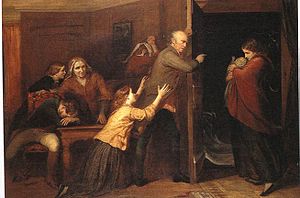
The Outcast, past Richard Redgrave, 1851. A patriarch casts his daughter and her illegitimate babe out of the family unit home.

Magdalene laundries were institutions that existed from the 18th to the late 20th centuries, throughout Europe and North America, where "fallen women", including single mothers, were detained. Photo: Magdalene laundry in Ireland, ca. early on twentieth century.[97]
Certainty of paternity has been considered important in a broad range of eras and cultures, especially when inheritance and citizenship were at stake, making the tracking of a man's manor and genealogy a cardinal part of what divers a "legitimate" birth. The ancient Latin dictum, "Mater semper certa est" ("The [identity of the] mother is always certain", while the begetter is non), emphasized the dilemma.
In English common law, Justice Edward Coke in 1626 promulgated the "Iv Seas Rule" (extra quatuor maria) asserting that, absent impossibility of the begetter being fertile, in that location was a presumption of paternity that a married adult female'due south child was her husband's child. That presumption could be questioned, though courts generally sided with the presumption, thus expanding the range of the presumption to a Seven Seas Rule". Merely it was only with the Union Act 1753 that a formal and public matrimony anniversary at ceremonious police force was required, whereas previously spousal relationship had a safe oasis if celebrated in an Anglican church. Yet, many "clandestine" marriages occurred.
In many societies, people built-in out of wedlock did non take the same rights of inheritance as those within it, and in some societies, fifty-fifty the same ceremonious rights.[ which? ] In the United Kingdom and the United States, as belatedly equally the 1960s and in certain social strata fifty-fifty up to today, nonmarital birth has carried a social stigma.[98] [99] In previous centuries unwed mothers were forced by social pressure to give their children upwards for adoption. In other cases nonmarital children have been reared by grandparents or married relatives every bit the "sisters", "brothers" or "cousins" of the unwed mothers.[100]
In most national jurisdictions, the status of a kid equally a legitimate or illegitimate heir could be changed—in either direction—under the civil law: A legislative act could deprive a child of legitimacy; conversely, a marriage between the previously unmarried parents, usually inside a specified fourth dimension, such equally a year, could retroactively legitimate a child'southward nascency.
Fathers of illegitimate children frequently did non incur comparable censure or legal responsibility, due to social attitudes nearly sex, the nature of sexual reproduction, and the difficulty of determining paternity with certainty.
By the final third of the 20th century, in the United States, all the states had adopted uniform laws that codified the responsibility of both parents to provide support and intendance for a child, regardless of the parents' marital condition, and gave nonmarital as well every bit adopted persons equal rights to inherit their parents' property. In the early 1970s, a serial of Supreme Court decisions abolished most, if not all, of the common-police force disabilities of nonmarital birth, as being violations of the equal-protection clause of the Fourteenth Subpoena to the U.s. Constitution.[101] Mostly speaking, in the Us, "illegitimate" has been supplanted by the phrase "built-in out of marriage."
In dissimilarity, other jurisdictions (particularly western continental European countries) tend to favour social parentage over the biological parentage. Here a man (non necessarily the biological father) may voluntarily recognise the child to exist identified as the father, thus giving legitimacy to the child; the biological father does not accept any special rights in this expanse. In France a mother may refuse to recognise her own child (come across bearding birth).
A contribution to the decline of the concept of illegitimacy had been made by increased ease of obtaining divorce. Before this, the mother and father of many children had been unable to marry each other considering ane or the other was already legally jump, past civil or canon law, in a non-viable before matrimony that did non let divorce. Their only recourse, often, had been to look for the death of the earlier spouse(south). Thus Polish political and military leader Józef Piłsudski (1867–1935) was unable to marry his second wife, Aleksandra, until his first wife, Maria, died in 1921; past this time, Piłsudski and Aleksandra had two out-of-wedlock daughters.[102]
[edit]

Nonmarital birth has affected non merely the individuals themselves. The stress that such circumstances of birth once regularly visited upon families is illustrated in the case of Albert Einstein and his married womanhoped-for, Mileva Marić, who—when she became significant with the first of their 3 children, Lieserl—felt compelled to maintain split domiciles in different cities.[103] [104]

Some persons born outside of marriage take been driven to excel in their endeavors, for good or ill, past a desire to overcome the social stigma and disadvantage that attached to it. Nora Titone, in her book My Thoughts Be Bloody, recounts how the shame and ambition of actor Junius Brutus Booth'due south two actor sons built-in exterior of matrimony, Edwin Booth and John Wilkes Booth, spurred them to strive, every bit rivals, for achievement and acclaim—John Wilkes, the assassin of Abraham Lincoln, and Edwin, a Unionist who a year earlier had saved the life of Lincoln's son, Robert Todd Lincoln, in a railroad accident.[105]

Historian John Ferling, in his book Jefferson and Hamilton: The Rivalry That Forged a Nation, makes the same point: that Alexander Hamilton'southward nonmarital birth spurred him to seek accomplishment and distinction.[106]
The Swedish artist Anders Zorn (1860–1920) was similarly motivated by his nonmarital birth to bear witness himself and excel in his métier.[107]
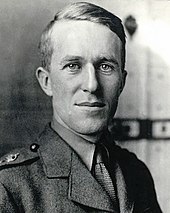
Similarly, T. E. Lawrence'southward biographer Flora Armitage writes about being born outside of spousal relationship: "The effect on [T. E.] Lawrence of this discovery was profound; it added to the romantic urge for heroic conduct—the dream of the Sangreal—the seed of ambition, the want for honour and stardom: the redemption of the claret from its taint."[98] Another biographer, John E. Mack, writes in a like vein: "[H]is female parent required of him that he redeem her fallen state past his own special achievements, by being a person of unusual value who accomplishes great deeds, preferably religious and ideally on an heroic scale. Lawrence did his all-time to fulfill heroic deeds. But he was plagued, particularly after the events of the war activated his inner conflicts, by a deep sense of failure. Having been deceived as a kid he was later to feel that he himself was a deceiver—that he had deceived the Arabs..."[108] "Mrs. Lawrence's original hope that her sons would provide her personal redemption by becoming Christian missionaries was fulfilled only past [Lawrence's brother] Robert."[109] Mack elaborates farther: "Role of his creativity and originality lies in his 'irregularity,' in his chapters to remain outside conventional ways of thinking, a tendency which... derives, at least in part, from his illegitimacy. Lawrence's chapters for invention and his ability to see unusual or humorous relationships in familiar situations come up also... from his illegitimacy. He was non express to established or 'legitimate' solutions or means of doing things, and thus his mind was open up to a wider range of possibilities and opportunities. [At the same time] Lawrence'due south illegitimacy had of import social consequences and placed limitations upon him, which rankled him securely... At times he felt socially isolated when onetime friends shunned him upon learning of his background. Lawrence's please in making fun of regular officers and other segments of 'regular' guild... derived... at least in part from his inner view of his ain irregular situation. His fickleness virtually names for himself [he changed his proper name twice to altitude himself from his "Lawrence of Arabia" persona] is directly related... to his view of his parents and to his identification with them [his father had inverse his name subsequently running off with T. E. Lawrence's future female parent]."[110]
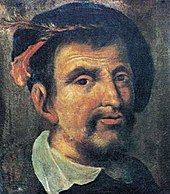
Christopher Columbus' first son, Diego Columbus (born betwixt 1474 and 1480; died 1526), by Columbus' wife, Filipa Moniz Perestrelo, followed in his father's footsteps to become the 2nd Admiral of the Indies, 2nd Viceroy of the Indies, and 4th Governor of the Indies.[111] Columbus' second son, Fernando Columbus (too known as Hernando; 1488–1539), was his out-of-wedlock son past Beatriz Enríquez de Arana and—while he grew up with a fair amount of power and privilege—due to the circumstances of his birth he never quite gained the prominence his begetter did. Hernando Columbus' biographer Edward Wilson-Lee[112] says Hernando "always wanted to prove himself his father'south son in spirit. [South]o he undertook th[e] extraordinary project [of] building a universal library that would [hold] every volume in the world... [H]eastward very much saw this as a analogue to his father'south desire to circumnavigate the earth.... Hernando was going to build a universal library that would circumnavigate the world of knowledge." Yet, realizing that such a large collection of books would not exist very useful without a style of organizing and distilling them, he employed an ground forces of readers to read every book and distill it down to a short summary, or "epitome". The result was the Libro de los Epitomes (Volume of Epitomes). Soon after Hernando's death in 1539 at age 50, this volume went missing for nigh 500 years—until in 2019 it was serendipitously discovered in a Academy of Copenhagen special collection. Many of the early printed publications that the Book of Epitomes summarizes are now lost; just cheers to the out-of-wedlock bibliophile Hernando Columbus, eager to emulate in his ain way his father and "legitimate" half-brother, invaluable insights are becoming available into the knowledge and thought of the early Modernistic Menstruum.[113]
Violence and honor killings [edit]
While births exterior marriage are considered acceptable in many world regions, in some parts of the globe they remain highly stigmatized. Women who have given nascence under such circumstances are often subjected to violence at the hands of their families; and may even become victims of so-called honor killings.[114] [115] [116] These women may as well be prosecuted under laws forbidding sexual relations outside union and may face consistent punishments, including stoning.[117]
In fiction [edit]
Illegitimacy has for centuries provided a motif and plot element to works of fiction by prominent authors, including William Shakespeare, Benjamin Franklin, Henry Fielding, Voltaire, Jane Austen, Alexandre Dumas, père, Charles Dickens, Nathaniel Hawthorne, Wilkie Collins, Anthony Trollope, Alexandre Dumas, fils, George Eliot, Victor Hugo, Leo Tolstoy, Ivan Turgenev, Fyodor Dostoyevsky, Thomas Hardy, Alphonse Daudet, Bolesław Prus, Henry James, Joseph Conrad, Eastward. Grand. Forster, C. S. Forester, Marcel Pagnol, Grace Metalious, John Irving, and George R. R. Martin.
Notables [edit]
Some pre-20th-century individuals whose anarchistic "illegitimate" origins did non prevent them from making (and in some cases helped inspire them to make) notable contributions to humanity's fine art or learning have included Leone Battista Alberti[118] (1404–1472), Leonardo da Vinci[119] (1452–1519), Erasmus of Rotterdam[120] (1466–1536), Jean le Rond d'Alembert[121] (1717–1783), James Smithson[122] (1764–1829), John James Audubon[123] (1785–1851), Alexander Herzen[124] (1812—1870), Jenny Lind[125] (1820–1887), and Alexandre Dumas, fils [126] (1824–1895).
Meet also [edit]
- Affiliation (family law)
- Anne Orthwood's bastard trial
- Bastard (Jewish police)
- Bastard (police of England and Wales)
- Childwite
- Colonial American bastardy laws
- Defect of nativity
- Filiation
- Hague Adoption Convention
- Illegitimacy in fiction
- Legitimacy constabulary in England and Wales
- Legitime
- Marks of distinction
- Nonmarital nativity rates past country
- Non-paternity outcome
- Orphan
- Unintended pregnancy
References [edit]
- ^ "Archived re-create". Archived from the original on 2012-02-05. Retrieved 2012-03-20 .
{{cite web}}: CS1 maint: archived copy as championship (link) - ^ Alan Macfarlane, "Illegitimacy and illegitimates in English language history." (2002), Alanmacfarlane.com
- ^ William Blackstone (1753), Commentaries on the Laws of England, Book Two, Chapter XV "Of Title by Purchase and I. Escheat", Section v.
- ^ Thomas Smibert (1850). The clans of the Highlands of Scotland: an business relationship of their register, with delineations of their tartans, and family arms. pp. three–.
- ^ AB Wilkinson and KMcK Norrie, The Law Relating to Parent and Child in Scotland, W.Light-green, Edinburgh 2nd Ed 1999 para one.54
- ^ "Category: Baptisms". Genealogy and Family History in Scotland. 12 April 2017. Retrieved 9 July 2018.
- ^ Legitimacy Act 1926 (xvi & 17 Geo. v c. lx)
- ^ Viscount of Drumlanrig's Tutor 1977 SLT (Lyon Ct) 16
- ^ "Cosmic ENCYCLOPEDIA: The Defect of Nativity (Illegitimacy)". Retrieved 20 Apr 2016.
- ^ "Parental rights and responsibilities". Retrieved 20 Apr 2016.
- ^ "US Supreme Court Cases from Justia & Oyez". Retrieved nineteen July 2011.
- ^ "Archived re-create" (PDF). Archived from the original (PDF) on 2015-04-14. Retrieved 2015-04-07 .
{{cite spider web}}: CS1 maint: archived copy as title (link) - ^ Watson vs. the United States, specifically the USCIS denial letter in Exhibit S, Hklaw.com
- ^ east.k. section 1 of the Police force Reform (Parent and Kid) (Scotland) Act 1986 (as amended in 2006) which abolished the status of illegitimacy.
- ^ Serge BRAUDO. "Autorité parentale - Définition". Retrieved xx April 2016.
- ^ "National Report: France" (PDF). Ceflonline.cyberspace . Retrieved 2017-03-26 .
- ^ "LOI n° 2009-61 du 16 janvier 2009 ratifiant l'ordonnance n° 2005-759 du iv juillet 2005 portant réforme de la filiation et modifiant ou abrogeant diverses dispositions relatives à la filiation - Legifrance". Retrieved 20 April 2016.
- ^ http://hudoc.echr.coe.int/sites/eng/pages/search.aspx?i=001-116716#{%22itemid%22:[%22001-116716%22]}
- ^ "Family unit CODE : In strength from 01.ten.2009 : Chapter one: GENERAL PROVISIONS" (PDF). Kenarova.com . Retrieved 2017-03-26 .
- ^ "Liste complète". Agency des Traités . Retrieved 20 April 2016.
- ^ "Liste complète". Bureau des Traités . Retrieved 20 Apr 2016.
- ^ "Instructions for N-600, Application for Certificate of Citizenship" (PDF). U.S. Citizenship and Immigration Services. Retrieved 1 October 2010.
- ^ Tuan Anh Nguyen et al. v. Clearing and Naturalization Service , 533 U.S. 53 (2001).
- ^ "Nationality policy: children of single parents" (PDF). Version 2.0. Home Role. vi November 2018.
- ^ "Elizabeth I". The Stuart Successions Project.
- ^ "Catechism 1137". Code of Canon Police. Libreria Editrice Vaticana. Retrieved 2021-12-15 .
The children conceived or born of a valid or putative wedlock are legitimate.
- ^ The Guardian (13 March 2013). "Pope Francis on gay spousal relationship, unmarried mothers … and journalists". London.
- ^ Fox (xiii March 2013). "Francis is offset pope from the Americas". Trick News.
- ^ ABC News. "Francis Becomes Offset Latin American Pope". Abcnews.become.com . Retrieved 2017-03-26 .
- ^ a b c "Irresolute Patterns of Nonmarital Childbearing in the United States". CDC/National Heart for Health Statistics. May 13, 2009. Retrieved Jan 11, 2021.
- ^ Grove, Robert D.; Hetzel, Alice M. (1968). Vital Statistics Rates in the United States 1940-1960 (PDF) (Report). Public Wellness Service Publication. Vol. 1677. U.S. Department of Health, Education, and Welfare, U.S. Public Health Service, National Heart for Wellness Statistics. p. 185.
- ^ Ventura, Stephanie J.; Bachrach, Christine A. (October xviii, 2000). Nonmarital Childbearing in the United states, 1940-99 (PDF) (Report). National Vital Statistics Reports. Vol. 48. Centers for Affliction Control and Prevention, National Center for Health Statistics, National Vital Statistics System. pp. 28–31.
- ^ Martin, Joyce A.; Hamilton, Brady East.; Ventura, Stephanie J.; Menacker, Fay; Park, Melissa M. (February 12, 2002). Births: Final Information for 2000 (PDF) (Report). National Vital Statistics Reports. Vol. l. Centers for Disease Control and Prevention, National Center for Wellness Statistics, National Vital Statistics System. p. 46.
- ^ Martin, Joyce A.; Hamilton, Brady Eastward.; Ventura, Stephanie J.; Menacker, Fay; Park, Melissa G.; Sutton, Paul D. (December xviii, 2002). Births: Final Data for 2001 (PDF) (Study). National Vital Statistics Reports. Vol. 51. Centers for Affliction Command and Prevention, National Center for Health Statistics, National Vital Statistics Organisation. p. 47.
- ^ Martin, Joyce A.; Hamilton, Brady E.; Sutton, Paul D.; Ventura, Stephanie J.; Menacker, Fay; Munson, Martha L. (Dec 17, 2003). Births: Final Data for 2002 (PDF) (Report). National Vital Statistics Reports. Vol. 52. Centers for Disease Control and Prevention, National Heart for Wellness Statistics, National Vital Statistics System. p. 57.
- ^ Martin, Joyce A.; Hamilton, Brady E.; Sutton, Paul D.; Ventura, Stephanie J.; Menacker, Fay; Munson, Martha L. (September 8, 2005). Births: Final Information for 2003 (PDF) (Report). National Vital Statistics Reports. Vol. 54. Centers for Affliction Control and Prevention, National Center for Wellness Statistics, National Vital Statistics Arrangement. p. 52.
- ^ Martin, Joyce A.; Hamilton, Brady East.; Sutton, Paul D.; Ventura, Stephanie J.; Menacker, Fay; Kirmeyer, Sharon (September 29, 2006). Births: Concluding Data for 2004 (PDF) (Report). National Vital Statistics Reports. Vol. 55. Centers for Disease Control and Prevention, National Middle for Health Statistics, National Vital Statistics System. p. 57.
- ^ Martin, Joyce A.; Hamilton, Brady E.; Sutton, Paul D.; Ventura, Stephanie J.; Menacker, Fay; Kirmeyer, Sharon; Munson, Martha Fifty. (Dec 5, 2007). Births: Final Data for 2005 (PDF) (Study). National Vital Statistics Reports. Vol. 56. Centers for Disease Command and Prevention, National Centre for Wellness Statistics, National Vital Statistics System. p. 57.
- ^ Martin, Joyce A.; Hamilton, Brady Eastward.; Sutton, Paul D.; Ventura, Stephanie J.; Menacker, Fay; Kirmeyer, Sharon; Mathews, T.J. (January 7, 2009). Births: Last Data for 2006 (PDF) (Report). National Vital Statistics Reports. Vol. 57. Centers for Disease Command and Prevention, National Center for Health Statistics, National Vital Statistics Organisation. p. 54.
- ^ Martin, Joyce A.; Hamilton, Brady E.; Sutton, Paul D.; Ventura, Stephanie J.; Mathews, T.J.; Kirmeyer, Sharon; Osterman, Michelle J.K. (August 9, 2010). Births: Final Data for 2007 (PDF) (Report). National Vital Statistics Reports. Vol. 58. Centers for Disease Control and Prevention, National Centre for Health Statistics, National Vital Statistics System. p. 46.
- ^ Martin, Joyce A.; Hamilton, Brady E.; Sutton, Paul D.; Ventura, Stephanie J.; Mathews, T.J.; Osterman, Michelle J.K. (December eight, 2010). Births: Final Data for 2008 (PDF) (Study). National Vital Statistics Reports. Vol. 59. Centers for Affliction Control and Prevention, National Heart for Health Statistics, National Vital Statistics System. p. 46.
- ^ Martin, Joyce A.; Hamilton, Brady Eastward.; Ventura, Stephanie J.; Osterman, Michelle J.1000.; Kirmeyer, Sharon; Mathews, T.J.; Wilson, Elizabeth C. (November three, 2011). Births: Concluding Information for 2009 (PDF) (Written report). National Vital Statistics Reports. Vol. 60. Centers for Disease Command and Prevention, National Eye for Wellness Statistics, National Vital Statistics System. p. 46.
- ^ Martin, Joyce A.; Hamilton, Brady Due east.; Ventura, Stephanie J.; Osterman, Michelle J.G.; Wilson, Elizabeth C.; Mathews, T.J. (August 28, 2012). Births: Final Data for 2010 (PDF) (Study). National Vital Statistics Reports. Vol. 61. Centers for Illness Control and Prevention, National Middle for Health Statistics, National Vital Statistics Arrangement. p. 45.
- ^ Martin, Joyce A.; Hamilton, Brady E.; Ventura, Stephanie J.; Osterman, Michelle J.K.; Mathews, T.J. (June 28, 2013). Births: Final Information for 2011 (PDF) (Report). National Vital Statistics Reports. Vol. 62. Centers for Illness Control and Prevention, National Center for Health Statistics, National Vital Statistics System. p. 43.
- ^ Martin, Joyce A.; Hamilton, Brady Eastward.; Osterman, Michelle J.Thou.; Curtin, Sally C. (December 30, 2013). Births: Last Data for 2012 (PDF) (Report). National Vital Statistics Reports. Vol. 62. Centers for Illness Control and Prevention, National Heart for Wellness Statistics, National Vital Statistics System. p. 41.
- ^ Martin, Joyce A.; Hamilton, Brady Eastward.; Osterman, Michelle J.K.; Curtin, Emerge C.; Mathews, T.J. (Jan 15, 2015). Births: Final Data for 2013 (PDF) (Study). National Vital Statistics Reports. Vol. 64. Centers for Disease Control and Prevention, National Center for Wellness Statistics, National Vital Statistics System. p. forty.
- ^ Hamilton, Brady Eastward.; Martin, Joyce A.; Osterman, Michelle J.K.; Curtin, Sally C.; Mathews, T.J. (December 23, 2015). Births: Final Data for 2014 (PDF) (Written report). National Vital Statistics Reports. Vol. 64. Centers for Disease Command and Prevention, National Center for Health Statistics, National Vital Statistics System. pp. 7 & 41.
- ^ "MPIDR - Spatial aspects of the rise of nonmarital fertility across Europe since 1960: the function of states and regions in shaping patterns of change". Demogr.mpg.de. Archived from the original on 2015-09-23. Retrieved 2017-03-26 .
- ^ "Share of births outside marriage and teenage births" (PDF). OECD Directorate for Employment, Labour, and Social Affairs. Retrieved Oct 19, 2009.
- ^ "Fertility Statistics". Eurostat. Retrieved Jan 20, 2010.
- ^ "National Vital Statistics Reports, Book 59, Number 3, December 21, 2010" (PDF).
- ^ "Our view on kids: When unwed births hit 41%, it's just not right". USA Today. 25 Jan 2011.
- ^ Ravitz, Jessica (April viii, 2009). "Out-of-wedlock births hit record high". CNN. Retrieved Oct 19, 2009.
- ^ a b c d eastward f g h i j thou "Eurostat - Tables, Graphs and Maps Interface (TGM) tabular array". Ec.europa.eu. 2016-08-11. Retrieved 2017-03-26 .
- ^ "Naissances hors mariage | Insee".
- ^ a b c d due east f k h "Eurostat - Tables, Graphs and Maps Interface (TGM) tabular array". ec.europa.eu.
- ^ "Births, Slovenia, 2016". www.stat.si.
- ^ a b c "PORDATA - Alive births outside of spousal relationship, with parents co-habiting or not (%) in Portugal". Pordata.pt. 2016-04-28. Retrieved 2017-03-26 .
- ^ [i]
- ^ "Population change - 1st half-year of 2017 | CZSO". Czso.cz . Retrieved 2017-10-17 .
- ^ "Marriage and divorce statistics - Statistics Explained". Epp.eurostat.ec.europa.eu. Retrieved 2014-04-04 .
- ^ a b "The low importance of union in eastern Germany – social norms and the role of peoples' perceptions of the past" (PDF). Demographic-research.org . Retrieved 2017-03-26 .
- ^ "[ARCHIVED CONTENT] Release Edition Reference Tables". Ons.gov.uk . Retrieved 20 April 2016.
- ^ "Résultats de la recherche | Insee". Insee.fr (in French). Retrieved 2017-03-26 .
- ^ "Résultats de la recherche | Insee". Insee.fr (in French). Retrieved 2017-03-26 .
- ^ "Tony Travers: Thanks to immigrants we're the capital for marriage". Evening Standard. 24 September 2013. Retrieved 20 Apr 2016.
- ^ "Proportion de naissances hors mariage1 selon le rang de naissance, Québec, 1976-2014". Institut de la Statistique du Québec. Retrieved xx Apr 2016.
- ^ a b "Proportion de naissances hors mariage selon le rang de naissance, Québec, 1976-2015". Stat.gouv.qc.ca . Retrieved 2017-03-26 .
- ^ "Births". STATISTIK Austria. Retrieved xx Apr 2016.
- ^ "Eurostat - Tables, Graphs and Maps Interface (TGM) table". ec.europa.european union.
- ^ "Population change - 1st - third quarter of 2015 | CZSO". Czso.cz . Retrieved 2017-03-26 .
- ^ "Global Children's Trends | The Sustainable Demographic Dividend". Sustaindemographicdividend.org. Retrieved 2013-02-11 .
- ^ "Births outside marriage". Childtrends.org.
- ^ a b "Global Children's Trends - The Sustainable Demographic Dividend". Retrieved twenty April 2016.
- ^ "Illegitimate Nation: An Examination of Out-of-Matrimony Births Among Immigrants and Natives". June 2007.
- ^ "The Development of Births Outside of Matrimony, Paternal Recognition and Children's Rights in Brazil" (PDF). Paa2013.princeton.edu . Retrieved 2017-03-26 .
- ^ Grupo Copesa (thirteen July 2014). "Alza de hijos fuera del matrimonio muestra evolución de la familia en Chile". Retrieved 20 April 2016.
- ^ a b UN. "Alive births by legitimacy status, and percent illegitimate: 1990 - 1998" (PDF).
- ^ 2015 PSA data on live births by legitimacy by regions
- ^ Gilding, Michael (2005). "Rampant misattributed paternity: the creation of an urban myth". People and Place. thirteen (12): 1–11.
- ^ Gilding, M. (2009). "Paternity Doubt and Evolutionary Psychology: How a Seemingly Arbitrary Occurrence Fails to Follow Laws of Greater Generality". Sociology. 43: 140–691. doi:10.1177/0038038508099102. S2CID 145367552.
- ^ Philipp EE (1973) "Discussion: moral, social and ethical issues". In: Wolstenholme GEW, Fitzsimons DW, eds. Law and ethics of AID and embryo transfer. Ciba Foundation symposium. Vol 17. London: Associated Scientific 63–66
- ^ a b Bellis MA, Hughes K, Hughes South, Ashton JR (September 2005). "Measuring paternal discrepancy and its public wellness consequences". J Epidemiol Community Health. 59 (9): 749–54. doi:10.1136/jech.2005.036517. PMC1733152. PMID 16100312.
- ^ Sykes, B; Irven, C (2000). "Surnames and the Y chromosome". Am J Hum Genet. 66 (4): 1417–1419. doi:10.1086/302850. PMC1288207. PMID 10739766.
- ^ Male monarch, Turi Eastward.; Jobling, Marker A. (2009), "Founders, Drift, and Infidelity: The Relationship between Y Chromosome Diversity and Patrilineal Surnames", Molecular Biology and Evolution, 26 (5): 1093–102, doi:ten.1093/molbev/msp022, PMC2668828, PMID 19204044
- ^ Forster, P; Hohoff, C; Dunkelmann, B; Schürenkamp, M; Pfeiffer, H; Neuhuber, F; Brinkmann, B (2015). "Elevated germline mutation rate in teenage fathers". Proc Biol Sci. 282 (1803): 20142898. doi:10.1098/rspb.2014.2898. PMC4345458. PMID 25694621.
- ^ Griffin, Emma (2013). "Sex activity, illegitimacy and social modify in industrializing Britain'". Social History. 38 (2): 139–161. doi:10.1080/03071022.2013.790236. S2CID 143607918.
- ^ "UK | The no-sex 'myth'". BBC News. 2002-10-03. Retrieved 2017-03-26 .
- ^ a b "Currently cohabiting: relationship expectations and outcomes in the British Household Panel Survey (BHPS) : Ernestina Declension" (PDF). Epc2008.princeton.edu . Retrieved 2017-03-26 .
- ^ a b Elena von der Lippe (Koytcheva). "Contemporary union formation in Republic of bulgaria: the emergence of cohabitation". ResearchGate . Retrieved twenty April 2016.
- ^ "Why are cohabitation and actress-marital births so few in Japan?" (PDF). Demogr.mpg.de . Retrieved 2017-03-26 .
- ^ "Spain - SOCIAL VALUES AND ATTITUDES". Retrieved 20 April 2016.
- ^ Cherlin, Andrew J. (1 January 2004). "The Deinstitutionalization of American Spousal relationship". Periodical of Marriage and Family. 66 (four): 848–861. doi:ten.1111/j.0022-2445.2004.00058.x. JSTOR 3600162.
- ^ "The reproductive context of cohabitation in comparative perspective : Contraceptive use in the United States, Spain, and France" (PDF). Demographic-research.org . Retrieved 2017-03-26 .
- ^ Laplante, Benoît (i January 2006). "The Rise of Cohabitation in Quebec: Ability of Religion and Power over Religion". The Canadian Journal of Sociology. 31 (1): 1–24. doi:ten.2307/20058678. JSTOR 20058678.
- ^ "Archived re-create" (PDF). Archived from the original (PDF) on 2014-12-22. Retrieved 2014-05-06 .
{{cite web}}: CS1 maint: archived re-create as title (link) - ^ Figure nine, Frances Finnegan, Practise Penance or Perish, Congrave Press, 2001.
- ^ a b Flora Armitage, The Desert and the Stars: A Biography of Lawrence of Arabia, p. 42.
- ^ John Due east. Mack, A Prince of Our Disorder: The Life of T.E. Lawrence, pp. 28–29, 32.
- ^ On the iv March 2011 Charlie Rose TV interview plan, British Nobel laureate Paul Nurse told such a story of "shame": he was reared by his grandparents every bit the supposed younger blood brother of his now-deceased biological mother, and has never learned who his biological begetter was.
- ^ "Illegitimacy". Justia. Retrieved 2009-10-19 .
- ^ Andrzej Garlicki, "Piłsudski, Józef Klemens," Polski słownik biograficzny, vol. XXVI, 1981, pp. 320, 323.
- ^ J. Renn and R. Schulmann, Albert Einstein / Mileva Marić: The Love Letters, 1992, pp. 73–74, 78.
- ^ Alice Calaprice and Trevor Lipscombe, Albert Einstein: A Biography, Greenwood Publishing Group, 2005, ISBN 978-0-313-33080-3, pp. 22–23.
- ^ Nora Titone. My Thoughts Exist Bloody: The Bitter Rivalry Betwixt Edwin and John Wilkes Booth That Led to an American Tragedy. New York: Simon and Schuster; 2010 [cited September 24, 2011]. ISBN 978-1-4165-8605-0.
- ^ Discussed past Ferling in a nine October 2013 lecture on C-SPAN2 Book TV.
- ^ "Anders Zorn in the Golden Age", PBS biography (Colorado Public Telly), one hour, 2013.
- ^ John E. Mack, A Prince of Our Disorder: The Life of T. East. Lawrence, 1976, p. 28.
- ^ John E. Mack, A Prince of Our Disorder: The Life of T. E. Lawrence, 1976, p. 32.
- ^ John E. Mack, A Prince of Our Disorder: The Life of T. Eastward. Lawrence, 1976, pp. 28–29.
- ^ "Diego Columbus". Encyclopedia Britannica.
- ^ Edward Wilson-Lee, The Catalogue of Shipwrecked Books: Young Columbus and the Quest for a Universal Library, William Collins, 2018.
- ^ Ari Shapiro, "Christopher Columbus' Son Had an Enormous Library. Its Itemize Was Simply Found", All Things Considered, NPR newscast, 24 April 2019 [2]
- ^ "BBC - Ethics: Honour Crimes". Retrieved 20 April 2016.
- ^ "Refugee Review Tribunal, AUSTRALIA : RRT RESEARCH RESPONSE". Archived from the original on 2013-05-01. Retrieved 2017-03-26 .
{{cite spider web}}: CS1 maint: bot: original URL status unknown (link) - ^ "Turkey condemns 'honour killings'". BBC News. 1 March 2004.
- ^ "Nigeria stoning appeal adjourned". CNN. 3 June 2003.
- ^ Joan Kelly-Gadol, "Leon Battista Alberti" (last updated 21 April 2021), Encyclopaedia Britannica [3]
- ^ "Leonardo da Vinci", The Encyclopedia Americana, vol. 17, pp. 228-236, Danbury, CT, Grolier Incorporated, 1986, ISBN 0-7172-0117-i, p. 228.
- ^ "Erasmus", The Encyclopedia Americana, vol. 10, pp. 541–542, Danbury, CT, Grolier Incorporated, 1986, ISBN 0-7172-0117-one, p. 541.
- ^ "Alembert, Jean le Rond d'", The Encyclopedia Americana, vol. 1, Danbury, CT, Grolier Incorporated, 1986, ISBN 0-7172-0117-one, p. 526.
- ^ "Smithson, James", The Encyclopedia Americana, vol. 25, Danbury, CT, Grolier Incorporated, 1986, ISBN 0-7172-0117-1, p. 65.
- ^ "Audubon, John James", The Encyclopedia Americana, vol. 2, Danbury, CT, Grolier Incorporated, 1986, ISBN 0-7172-0117-one, p. 677.
- ^ "Herzen, Aleksandr Ivanovich", The Encyclopedia Americana, vol. 14, Danbury, CT, Grolier Incorporated, 1986, ISBN 0-7172-0117-1, pp. 161-162.
- ^ Carole Rosen (2004), "Lind (married proper noun Lind-Goldschmidt), Jenny (Johanna Maria)", doi:ten.1093/ref:odnb/16671, in Oxford Lexicon of National Biography (subscription required).
- ^ "Dumas, Alexandre", The Encyclopedia Americana, vol. ix, Danbury, CT, Grolier Incorporated, 1986, ISBN 0-7172-0117-1, pp. 466-467.
Bibliography [edit]
- Flora Armitage, The Desert and the Stars: a Biography of Lawrence of Arabia, illustrated with photographs, New York, Henry Holt and Visitor, 1955.
- Andrzej Garlicki, "Piłsudski, Józef Klemens," Polski słownik biograficzny, vol. XXVI, Wrocław, Polska Akademia Nauk, 1981, pp. 311–24.
- Shirley Foster Hartley, Illegitimacy, Academy of California Press, 1975.
- Alysa Levene, Thomas Nutt & Samantha Williams, eds. Illegitimacy in United kingdom of great britain and northern ireland, 1700–1920. Palgrave Macmillan; 2005 [cited 24 September 2011]. ISBN 978-1-4039-9065-v.
- John E. Mack. A Prince of Our Disorder: The Life of T. E. Lawrence. Harvard University Press; 1998 [cited September 24, 2011]. ISBN 978-0-674-70494-7.
- Charles Simic, "You Laugh Uncontrollably" (review of Bohumil Hrabal, Mr. Kafka and Other Tales from the Time of the Cult, translated from the Czech by Paul Wilson, New Directions, 142 pp., $14.95 [paper]), The New York Review of Books, vol. LXIII, no. 8 (May 12, 2016), pp. 58–60.
- Jenny Teichman. Illegitimacy: an examination of bastardy. Cornell University Press; 1982 [cited September 24, 2011]. ISBN 978-0-8014-1491-6.
- Nora Titone, My Thoughts Be Bloody: The Biting Rivalry between Edwin and John Wilkes Booth that Led to an American Tragedy, New York, Simon and Schuster, 2010 [cited September 24, 2011], ISBN 978-one-4165-8605-0.
External links [edit]
- Percentage of Births to Unmarried Mothers by Land: 2014 (distribution of births outside wedlock beyond the United States)
- Cuckolded fathers rare in human populations
- Ari Shapiro, "Christopher Columbus' Son Had an Enormous Library. Its Catalog Was Just Institute", All Things Considered, NPR newscast, 24 April 2019 [4]
If You Have a Baby and Then Get Married Are They Still a Bastard
Source: https://en.wikipedia.org/wiki/Legitimacy_(family_law)
0 Response to "If You Have a Baby and Then Get Married Are They Still a Bastard"
Post a Comment