Do It Again in C Without Cello
In the Limited Lane: Learning the Cello as an Developed
by Ethan Winer - written in 1997
Exist sure to see my consummate Music Theory grade on YouTube.
(Some segments are blocked in some countries, and so it's likewise on Vimeo.)
Cello Discovery - Affordable, online cello lessons for the adult beginner.
I began playing the cello at the age of 43, and at the fourth dimension considered myself fortunate to undertake this admittedly large projection every bit an adult. As an adult I didn't have to debate with the trauma of outgrowing an instrument. I'd also played other instruments (electric guitar, Fender bass, some piano), and already understood how music "works." Maybe nearly important, I had a determination to succeed that few children possess.
But starting as an adult too has unique drawbacks. Playing endless variations of "Twinkle Twinkle Little Star" is hardly interesting to someone who's studied musical scores and performed publicly. Worse, I knew how good music is supposed to be played, and my early on efforts were not even shut. Beginner children don't know how bad they audio, and thus are not so easily discouraged! Having played blues lead guitar for many years I knew what it felt similar to be in control of an instrument - to play with feeling and conviction. I really hated being demoted to mediocre status equally a beginner on the cello, and wanted to get past that phase as apace as possible. What I hoped would be an enjoyable pastime soon evolved into an obsession to get practiced as quickly equally possible that now occupies 3 or four hours of each day.
In the v years since I began playing the cello I've fabricated a number of observations that I believe other developed beginners and intermediate players - peculiarly those who are ambitious and are willing to piece of work hard - will find useful. Like Sergeant Joe Friday on the TV bear witness Dragnet, I take always been a seeker of "but the facts." I'm non interested in guesses, half-baked opinions, or anything that can't be substantiated. The facts I wanted to know are ane) What skills are needed to become an achieved cellist, and 2) How exercise I get there in the shortest amount of time?
In a previous career I owned a software company, and wrote books and magazine manufactures about computer programming. Being a successful programmer requires knowing the facts, and learning to play an musical instrument really is no different. Even so, to become a proficient thespian requires learning the facts and likewise developing the necessary mechanical skills. A good musician possesses "fine motor command" equally well as the artistic sense to know how to apply that control.
I'm convinced that what is oftentimes mistaken for musical talent or bent is really persistence and enough belief in i's self to continue at it. It takes thousands of practice hours to achieve competence and even more than to become truly polished. Unfortunately, many people give up long earlier so, mistakenly believing they don't have the needed ability. But like walking and talking, most of the skills necessary for playing an instrument are purely mechanical and tin can be adult past anyone given enough time. How ane actually applies that mechanical, muscular control is what distinguishes the truly talented from the but competent.
WHAT YOUR TEACHER WON'T TELL You lot
Most of my studying has been with one teacher, to whom I remain devoted. Only I've also taken single lessons from a number of other teachers, to become additional opinions and to hear as many different viewpoints as possible. The more than my understanding of the cello has grown, the more surprised I am that few of these teachers addressed certain mechanical aspects of playing the cello - in particular, the importance and difficulty of the bow.
Many professional cellists and teachers achieve a cute tone, yet cannot describe what it is they do physically to go that tone. I've been told, "Draw the sound out, don't push it inward," which conveys no information and provides no guidance for how to do that! Likewise, comments such as "Make a big sound" and "Play with more resonance" are equally useless. Resonance is a concrete property (a propensity to vibrate), not something that a player controls. And a good cellist can brand a "large sound" even when playing very softly. In the pursuit of a cute tone, bowing is the unmarried most of import skill to chief. Bowing is the cello's voice, and everything else revolves around that.
Bowing an instrument is an inherently awkward human action. Information technology is easy for a teacher who has been playing since an early age to overlook the amount of strength and control needed just to depict the bow smoothly. What happens in the commencement few milliseconds of a notation has an enormous bearing on the perceived character of the entire annotation. A scratchy tone or flat pitch caused by too fast or too slow a bow speed - even if corrected chop-chop - volition brand the entire annotation or passage sound amateurish. Decision-making a bow and changing its direction are some of the near difficult things to master, yet shine bow changes are fundamental to playing the cello. Until y'all tin can change bow direction without making a scratching sound, every note yous play will sound lame. If yous listen to a recording of any neat cellist playing a tedious passage you volition notation that every bow modify is flawless and beautiful - all yous hear at each note transition is the slightest dip in book.
Note initiations tin be sudden with a biting event, or they can be gentle followed by a gradual increase in book. But a biting start should never be distorted or scratchy. Cello strings are thick and heavy, and information technology takes a lot of strength to get them moving. Merely pressing even a petty besides hard or drawing the bow fifty-fifty a little too fast ruins the sound. Even more than difficult is irresolute bow direction while also changing the bow to a different string. These are the things a beginner must focus on the most to overcome sounding like a beginner.
Another obstacle is developing an independence of the left and right arms and hands. Not unlike the joke most walking and chewing gum at the aforementioned time, information technology is harder to move your left hand accurately on the fingerboard while likewise irresolute the bow management. I've theorized that the brain splits its concentration between the ii hands, making it harder to control the bow and the left paw fingers at the same time. There are difficult passages I tin can play confidently and in tune using pizzicato, but that are weak and out of tune when played with the bow. Likewise, I can do a smoother bow change if I kickoff cease the vibrato. I know in time bowing will become automatic, and at that betoken I'll piece of work at continuing vibrato upward to the exact moment when a new note begins.
Finally, many teachers stress that you should remain relaxed when you play. Merely how tin y'all possibly relax equally you approach a passage you know you have only a small chance of playing well? The fact is you lot can't! By all means try to relax - in my case I tend to grip the bow too tightly in a vain effort to gain control - but likewise accept that you won't go fully comfortable until you've been playing for many years.
PRACTICE SMARTER, Not HARDER
I won't dispute the value of conventional learning methods - studying etude books and progressively more than difficult student pieces - but I'1000 convinced in that location's an fifty-fifty faster way to become a competent cellist. It's been said that a calendar month of on-the-job training is equal to a twelvemonth of college. By extension, you will progress faster by working on real pieces rather than etudes and student compositions. Further, if yous practice etudes for three years, all you have to evidence for your effort is, well, etudes. However, if y'all kickoff now on a real concerto or sonata, you'll have learned and be able to play a beautiful and meaningful piece of music for the same amount of effort. But y'all also need to develop mechanical facility.
My practice hours are divided about equally between works from the standard cello literature and highly focused mechanical exercises. It is these exercises that I want to share here, and I'm convinced they are more useful than an etude book for a motivated adult student. I have practiced these exercises daily for five years now, and I can attest that they work and work well. By focusing direct on the most difficult mechanical aspects of cello playing, you lot tin can reduce what might otherwise accept x or more than years to substantially less than that. Later mastering the mechanics you tin then work on the more creative aspects of this noble arts and crafts.
In the pursuit of a articulate tone, the Number One issue is achieving the ideal ratio of these three interrelated factors: bow speed, bow pressure, and bow distance from the span. Equally the bow is drawn faster, more pressure is required to maintain the optimum amount of friction. Information technology is this optimum friction that makes for a "large" sound. Cellists sometimes use less bow pressure or more speed to become a beautiful silky tone, which can be enhanced by placing the bow further from the bridge. A special consequence called Sul Ponticello uses a like technique with the bow placed very close to the span. But first you must develop the bow control needed to create a articulate tone - what I call a "pure buzz."
If the bow moves besides fast at the start of a note it creates a scratching audio; on sustained notes too much speed or too fiddling pressure makes the bow skate over the cord instead of digging into it. When the bow speed is also wearisome or the pressure level is too great the notation becomes distorted, or even flat in pitch. Besides, when the bow is nearer to the bridge more pressure is needed or, alternatively, the bow must be fatigued more slowly. This is especially apparent when playing fast passages on the lower strings when changing bow management for each note. Different notes - even on the same string - also take a unlike optimum speed for a given amount of pressure. As yous play the short instance in Figure ane (all on the K string), discover how difficult it is to prevent a cursory scratching sound every bit each new note begins.
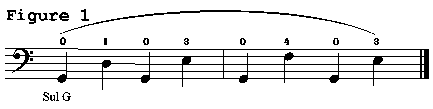
Achieving the optimum ratio of speed and pressure level is hardest when bowing well-nigh to the bridge, due to the very tiresome speed needed to sound a clear tone. Information technology'southward difficult to proceed such a slow speed steady. All the same this is where a soloist must play during loud passages, to rise above the residuum of the orchestra. It is harder still to bow slowly very near the frog end.
I exercise iii similar exercises to develop the command needed to smoothly change bow direction and maintain a pure tone during tiresome passages. The first exercise is simply drawing the bow back and forth on each string twenty times, trying to avoid a scratching sound when the bow changes direction. The scratching is caused by the bow traveling as well quickly, and these exercises strength yous to piece of work at reducing the speed. Place the bow within an inch of the bridge and an inch from the frog, and draw about two inches of bow in each direction keeping the bow in contact with the cord at all times. The other two exercises shown in Figures 2a and 2b are variations that help develop polish bow crossings. Practise each of these exercises as cleanly as possible on each string pair bowing virtually the frog, starting both down- and upward-bow, at least 20 times every twenty-four hour period.
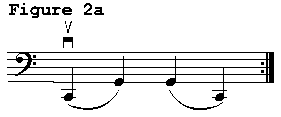
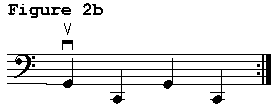
Equally valuable is practicing irksome scales, e'er drawing the bow fully from 1 terminate to the other. It is tempting to avoid the final few inches at each end of the bow, just I urge y'all not to. If something is hard to do or uncomfortable, that'due south a certain sign you need to practice it! Over again, try to reach a pure buzz, with no scuffing sound when the bow direction changes. Besides practice drawing the bow on each string equally slowly as possible, sustaining a single bow in each direction for at least 30 seconds or longer and as smoothly every bit possible. This is easiest to do when the bow is further abroad from the bridge. Baseball game players develop strength and control past swinging two bats at once. In a similar fashion, trying to bow more slowly than you'll always really need expedites developing a steady bow arm. The clandestine of making a powerful tone at depression volumes is keeping the bow very steady. It is the slight fluctuations in bow speed and pressure level that make a note sound wimpy, similar it's played by a beginner.
Another useful practice is what I telephone call "touch downs," which assist develop the power to drop the bow onto a cord without information technology bouncing. This is especially difficult to exercise near the tip of the bow. Starting at the frog end of the bow near a half inch in a higher place the C string, lower the bow slowly and carefully, draw one inch of bow, heighten it, back up a half inch, and repeat until you accept reached the tip. Do that once more working toward the frog, and then echo on the other strings. (I joke to my friends that I spend half my practice fourth dimension trying to keep the bow from bouncing when I don't want it to, and the other half trying to become it to bounce when it won't.)
Also valuable are what I recall of as the bowing equivalents to natural language twisters - exercises that for one reason or another are more difficult than they might appear on a printed folio. Changing the bow direction while also going to a dissimilar string is more difficult than staying on the same string. By focusing on bowing exercises that demand this movement you will practice the needed moves more often than they would occur in a normal piece or etude. These are shown in Figures 3a through 3e.
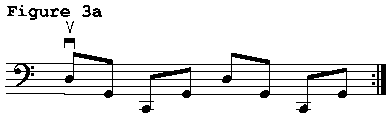
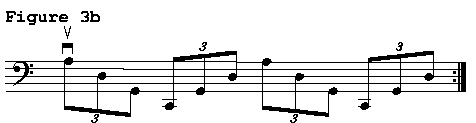
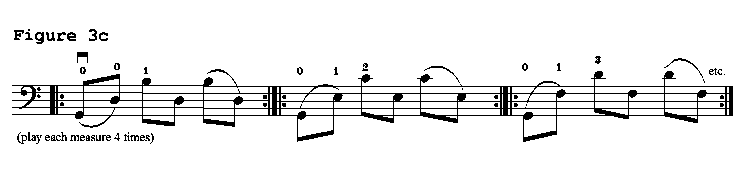
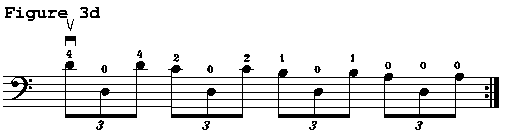
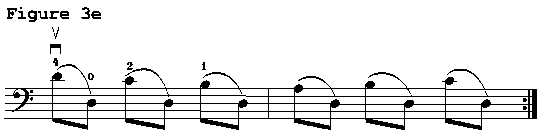
I spend a few minutes every mean solar day on each of these exercises, going equally slowly as necessary to sound each annotation clearly and not accidentally hit two strings at once. Then I do them once again as fast equally possible, ignoring that the bow doesn't dig optimally into the strings, to get my easily used to "making the motions" quickly and smoothly. Exercise the exercises in Figures 3d and 3e starting both down- and up-bow, and also on every string-pair.
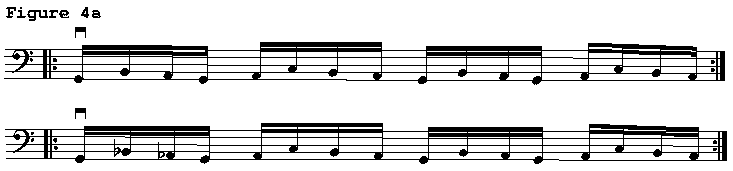
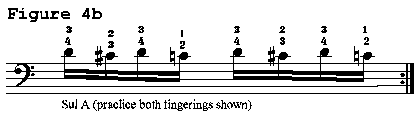
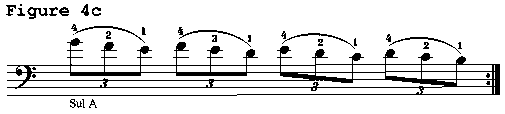
The exercises in 4a and 4b are as well harder to play than they look because the fingering itself is tricky. Effigy 4c is a real challenge to play in tune because it leads with the quaternary finger descending instead of the beginning finger which is more than usual. Push yourself to play these equally speedily as possible, but without making a jumble of the notes.
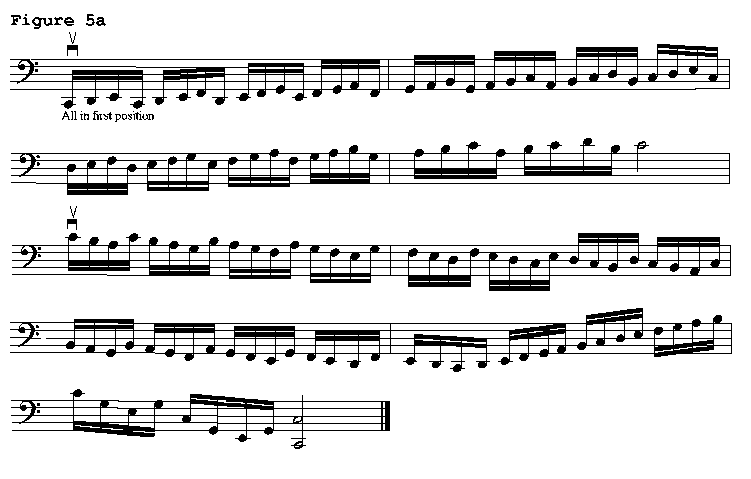
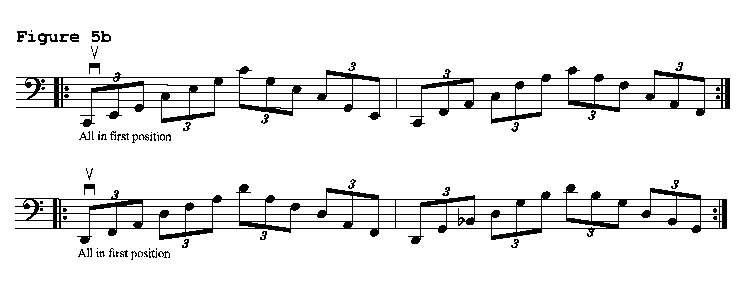
Besides the difficulty of mastering string crossings, information technology is a claiming only to coordinate bowing and fingering. The tried and true exercises in Figures 5a and 5b volition exist useful to players at any skill level; yous can never play them fast enough or cleanly enough. Again, practise them starting both downward- and upwards-bow, and commencement slowly and so speedily. Also do the exercise in Effigy 5a in the key of D (a whole pace higher) to get your left hand fingers used to the big stretches needed to play in that key in showtime position.
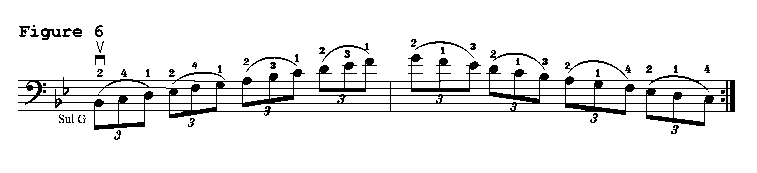
Bowing is important, but so are smoothen position shifts. The do in Figure vi is meant to be played all on the G cord, simply yous should also repeat information technology on the other strings. At each shift point endeavor to make the shift as smoothly as possible - never sudden or jerky. If you're non sure how to shift positions smoothly ask your teacher to bear witness you. At that place'due south a special style to do that which is not necessarily obvious. Go upward and down each string at to the lowest degree eight times, and y'all'll be amazed at how soon yous are comfortable playing near the very pinnacle of the fingerboard.
I also urge you to explore thumb position if y'all haven't already, and practise scales and arpeggios daily that extend to the highest positions on the cervix. Playing a four-octave arpeggio is not something you'll be able to practice all suddenly 1 day "when you are skillful." You have to starting time sometime, so why not today? Go as slowly as necessary to offset, and don't exist discouraged by how slowly y'all accept to play to stay in tune.
Finally, brand up your own exercises based on pieces you detect difficult to play. There are many other bowing and fingering exercises non shown here that I practise every day, and many were derived from one passage or another that I stumbled over during the course of playing real pieces. For case, when I had trouble playing this phrase from the Dvorak Concerto (Effigy vii):
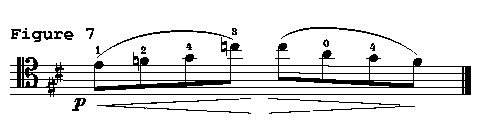
I made up the exercise shown in Figure 8 and added information technology to my daily to-practise list.

For an additional challenge, apply the 2d left hand finger instead of the third for the high note in the centre of each figure. So do information technology again using the beginning finger each time for that high note. This practice is particularly useful because it requires shifting repeatedly over the bad-mannered area where the neck joins the trunk of the cello.
Across EXERCISES
Mechanical exercises are valuable because they focus on specific aspects of cello technique. They are admittedly boring, but the work must be washed. However, exercises won't help you lot with sight reading, or further your understanding of musical concepts. The best way to improve your reading skills is to keep working on new pieces. Endeavor to find a local orchestra to play with, or start a piano trio or cord quartet. It'southward difficult to find avant-garde players willing to practice with a beginner, only at least try to find others who are as defended as you so you lot won't outgrow them. Many towns have a community orchestra you can join fifty-fifty if you are non that advanced. Play the passages you tin, and rest or play softly during the hard parts. Or play only the beginning note in each grouping of four sixteenth notes. Nobody volition mind if yous tin can't play everything perfectly, as long as you don't wreck it for the others by playing out of tune too loudly. Joining an apprentice orchestra has the added benefit of sitting abreast someone more than experienced who can show you fingerings and other techniques. After struggling for several months to learn spiccato, a cellist in a local grouping showed me the basic moves in five minutes during coffee interruption.
Equally valuable is attention concerts and watching video tapes. I have most of the cello videos available, and I've learned something useful from every one of them. The Shar catalog (800-248-SHAR) lists a number of videos - both teaching and complete performances - and for nearly the cost of an hour-long lesson they're a skilful value. I've as well bought quite a few play-along tapes from Music Minus One (914-592-1188). The just trouble with accompaniment tapes is they're played at total tempo, which is often too fast for a beginner. Also, minor variations in tape speed may require y'all to retune your instrument for each record. But nothing beats playing forth with superb musicians who get it right every fourth dimension. I've also created my own accompaniments in my MIDI recording studio, which has the reward of letting me vary the playback tempo over a very wide range without altering the pitch of the instruments.
AL FINE
If yous lookout an proficient cellist playing a difficult slice, information technology is tempting to recall, "That must be very difficult to do." Merely obviously it is not hard for that cellist! I have a wise friend who once pointed out "It's only hard if you can't practise it." Becoming skillful enough to perform an avant-garde slice with ease is what'south difficult. Playing any musical instrument is a lifetime commitment, and the best cellists are those who go along to practice their craft every mean solar day.
Ethan Winer lives in New Milford, Connecticut and at the time this was written played the cello in the Danbury Symphony. He produced the "Cello Master Course" videos featuring Bernard Greenhouse and has, at various times, earned a living as a studio musician, computer developer, sound engineer, composer/arranger, and technical writer. HIs video A Cello Rondo has received well-nigh two million views, though the version linked here is a newer "high definition" render. Also run across this interview I did with Kyle at the Play Cello web site.
Entire contents of this web site Copyright � 1997- past Ethan Winer. All rights reserved.
Source: https://ethanwiner.com/AdultBeg.html
0 Response to "Do It Again in C Without Cello"
Post a Comment